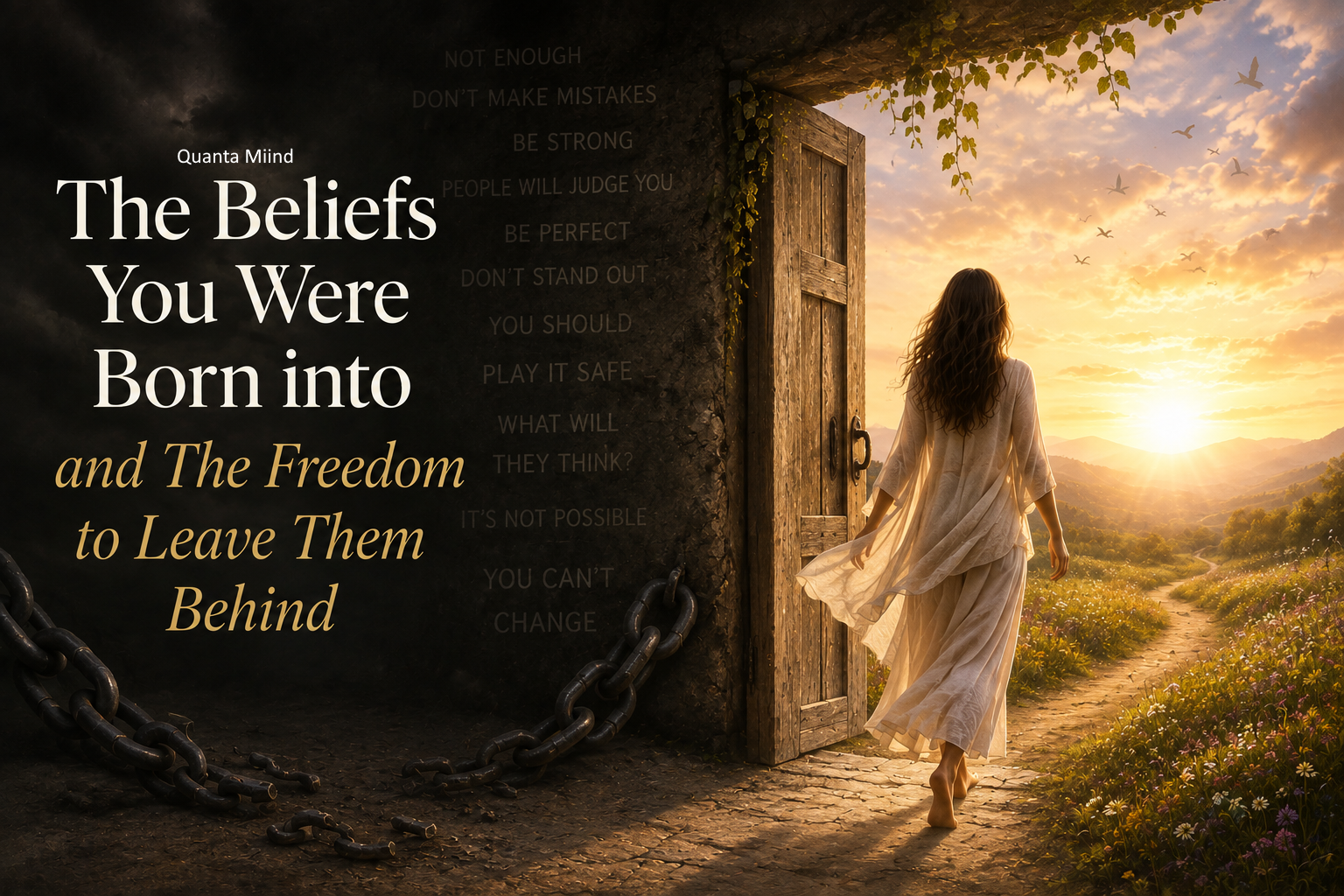
The Beliefs You Were Born into and The Freedom to Leave Them Behind
This blog is not about pointing fingers or about guilt or shame or political correctness. It is about something more personal than all of that: the discomforts, fears, and mistrusts that live inside you that you did not choose, and what becomes possible when you decide to look at them with your conscious choice.
Have you ever met someone from another country and, before they even said a word, something inside, told you to keep your distance?
Or heard the name of a religion and found yourself making assumptions about the person before you had learned a single thing about who they actually are?Have you noticed that you naturally feel warmer toward some people, while feeling guarded around others, even when neither person has done anything special to earn that response?Where does that reaction come from? Were you born with it? Is it really your own opinion, or is it something you have absorbed over time?The interesting question is not whether these reactions exist. Most of us have them in one form or another. The real question is whether we are willing to notice them, understand where they came from, and decide whether they still deserve a place in the way we see other human beings.
What Gets Passed Down
Every human being is born into a world that was already in progress. By the time you arrive, your family and community may already carry strong beliefs about who is safe and who is not, which faiths are familiar and which are viewed with suspicion, which countries are trusted and which are associated with conflict, danger, or loss. These beliefs are rarely passed down as formal lessons. More often, we absorb them through the people around us: the stories they tell, the warnings they repeat, the people they welcome, the people they avoid, the tension in their voices, and the reactions we see long before we understand their history. Over time, repeated exposure can make these responses feel natural and unquestionable. By telling you that the root of these beliefs may be found in your generational history, I am not saying that what your ancestors passed on to you was wrong. A discomfort around a particular religion may have roots in experiences your family lived through. A mistrust of a certain nationality may come from war, displacement, political conflict, or stories of harm that were repeated across generations. This is one way inherited bias can take shape. It does not mean that every reaction comes from our ancestors, or that we are destined to carry their fears. It means that families pass down more than traditions and values. They can also pass down assumptions, emotional responses, and ways of interpreting the world. Some of what feels deeply personal may therefore have a history that began long before us. The work is not to blame the generations before us. It is to become aware of what we have carried forward and ask a more important question: does this belief still belong in the way I see another human being today?
Why we Keep Finding the Evidence that the Ancestors were Right?
This is the interesting part. When we absorb a belief from our ancestors, it can be a fear, mistrust, a discomfort toward a particular group, or anything similar, the subconscious mind does not simply store it. It actively goes looking for evidence to confirm it because that’s how the subconscious mind works. The mind seeks to validate what it already believes. It filters incoming experience through the lens of existing beliefs, noticing the information that confirms them, dismissing or minimizing the information that contradicts them. So the person who inherited a mistrust of a particular religion will unconsciously pay more attention to the stories that confirm that mistrust; the news item, the difficult interaction, the behaviour of one person extrapolated to an entire faith of billions. And when that confirmation arrives, the whole nervous system feels settled knowing that the ancestors were right, that is exactly who these people are. And the cycle continues. What does not get registered with the same weight is the overwhelming counter-evidence of the millions of ordinary, contradictory, fully human individuals who share that faith or nationality and have nothing to do with the fears that were inherited. This is the confirmation loop of inherited bias. Each generation inherits the fear, finds the evidence, confirms the fear, and passes it forward as validated truth rather than ancestral wound. Breaking this loop requires more than exposure to contradictory evidence, though that helps too. It requires addressing the belief that is acting as a filter in the first place. Because as long as the underlying belief is operating, the mind will continue to find what it is looking for. The evidence will keep arriving. The ancestors will keep being proven right. Until the belief underneath changes. Then the same world starts to look different.
The Aim Is Not Agreement, It is Co-Existence
Something important needs to be said clearly before this blog goes any further. The goal of the work that we do, is not to reach a place where you agree with everyone, find every culture equally familiar, or erase the genuine differences that exist between people and communities. That is neither realistic nor necessary. The goal is coexistence. The freedom for every human being to live their life according to their own values, their own faith, their own cultural expression, without being reduced to the fears someone else inherited about them. You do not have to love every religion to stop carrying inherited fear of it. You do not have to agree with every cultural practice to stop treating its practitioners as less than fully human. You do not have to abandon your own identity, faith, values to extend basic dignity to someone who holds different ones. Coexistence is the willingness to share a world with people who are genuinely different from you without needing them to be more like you before you grant them their full humanity. That is the world self healing work is pointing toward. A world which has its differences and the differences are met with curiosity, where disagreement happens between equals rather than between a person and the perspective their bloodline created about another group of people. Every person gets to live the life that is theirs to live, every faith gets to be practiced by those who find meaning in it, every culture gets to exist without being required to justify itself to the fears of someone else's ancestors.
You do not have to abandon your own identity, faith, values to extend basic dignity to someone who holds different ones.
Coexistence is the willingness to share a world with people who are genuinely different from you without needing them to be more like you before you grant them their full humanity.
Six Things We Inherit Without Knowing
Most people, when they think about inherited bias, think of the obvious and extreme versions such as the overtly racist grandparent, the misogynist cultural norm or the explicit religious prejudice.
These are real but they are not where most inherited bias actually lives for most people. Here is what gets passed down most commonly:
1. Discomfort around certain religious or spiritual practices can persist even in people who are otherwise thoughtful, educated, and well-travelled. In recent months, I have had conversations with individuals who fit that description, and I mention travel because, in my view, it often broadens our understanding of how differently people live, believe, and make sense of the world.
Yet when discussions turned to current affairs, it became clear that some deeply held biases were difficult to question. There was an almost instinctive sense that certain faiths were more rational, more modern, or more legitimate than others.
These reactions rarely appear out of nowhere. They may be shaped by a community’s history of conflict with another faith, by divisions between sects within the same religion, or by families absorbing the prejudices and fears of the societies around them and passing those attitudes forward.
I will admit that these conversations can be difficult. Once someone has decided that the beliefs and assumptions familiar to them are more trustworthy than the lived reality of people outside their own tradition, evidence alone may not be enough to change their view. At that point, the challenge is no longer simply a lack of information. It is the willingness to examine the beliefs that have come to feel like truth.
2.Mistrust of particular nationalities can develop in much the same way. While reading online discussions, I often come across comments such as, “Don’t ruin the experience for the rest of us,” or, “Now we will all have to suffer because of what this particular group is doing.”
Comments like these show how quickly the actions of a few people can become attached to an entire nationality or community. A negative incident is repeated, discussed, shared, and eventually absorbed into the wider social narrative. Over time, that narrative can begin to shape expectations about people who had nothing to do with the original event.
Of course, no nationality is made up of people who all think, behave, or believe in the same way. Yet once a stereotype becomes familiar, it can influence how others are approached before any personal interaction has taken place. A person may be treated with caution, suspicion, or distance simply because of the country they come from.
This is how collective mistrust can take root. It begins with real or perceived experiences, but it becomes problematic when those experiences are generalized and applied to individuals who have never given us a reason to distrust them.
The more often a belief is repeated within families, communities, media, or social groups, the more easily it can begin to feel like common sense rather than an assumption (collective consciousness). And when an assumption starts to feel like common sense, we are less likely to question where it came from or whether it is still fair.
3.Inherited misogyny and gender bias: the belief that gender determines worth, capability, or entitlement. This is one of the most universal of all inherited tensions, present across every culture and faith in different forms. It can look like an assumption about what someone is capable of, or what role they naturally belong in, that was never consciously chosen.
4.Class prejudice: assumptions about intelligence, values, and worth that are linked to economic status. Inherited from ancestors who survived poverty, or from ancestors who defined themselves through status as dismissal of those with less.
5.Cultural superiority: the sense that the way your culture does things is simply more sensible, more evolved, or more correct. The default assumption that your norms are the standard from which others deviate.
6.Racial and ethnic discomfort: Absorbed from environments where certain groups were consistently portrayed as “other”, as less, as threat, through media, through community, through the stories that were told and the ones that were not.
None of these are comfortable to look at. The discomfort of recognition is, for most people, immediate and strong. And the most common response to that discomfort is to move away from it quickly, to say not me, I am not like that, I was raised differently.
The Good News
The good news is, it does not matter what racism, misogyny, hatred, or fear you inherited from your ancestors. Being an adult, you can unlearn all of it. You have the intelligence, the awareness, and the capacity to look at what was handed to you honestly, without self-punishment and decide what you want to do with it. That decision is one of the most meaningful acts of freedom available to a human being. The inherited belief does not have to run the rest of your life. It is information about your ancestors' unresolved experience, their fear, pain, their limited encounter with a world that was itself frightened and limited. It made sense in the environment that created it. But you know what, you are not in that environment anymore and you have to remind your nervous system of the same.
Understanding is Not Enough and Why That Matters
Understanding that you carry an inherited bias does not automatically release it. Knowing where a tension came from, being able to trace it to a historical conflict, a family wound, a cultural conditioning does not make the tension stop activating in your body. The knowledge lives in the conscious mind. The bias lives in the subconscious mind, the nervous system, the body, in the part of the mind that is running 90% of your daily experience without your awareness.
You cannot always think your way out of a subconscious pattern. You can become aware of it, and that awareness is essential, but awareness is only the beginning. What you do with that awareness is a separate part of the work.For instance, in the work I do with clients, we may identify a belief that, within ThetaHealing, we describe as sitting at the genetic or history level. At that point, the work goes beyond simply understanding the belief intellectually. We begin to look at where it may have come from, how it has been carried forward, and the ways it may still be influencing the person’s life, relationships, choices, or emotional responses.Once a client can see the pattern more clearly, the next step is to create movement around it. That may involve changing the belief itself through the healing work, but it also means asking what needs to change in everyday life. What boundary needs to be set? What conversation needs to happen? What habit needs to be interrupted? What response needs to be practiced differently?Those steps are not always easy. A familiar pattern can feel safer than an unfamiliar one, even when it is no longer serving us. But change has to begin somewhere, and often it begins with one small decision that is different from the one we have made before.This is where awareness becomes useful. It stops being something we merely understand and starts becoming something we can act on. A familiar pattern can feel safer than an unfamiliar one,
even when it is no longer serving us.
But change has to begin somewhere and often it begins with one small decision that is different than the one we have made before.
Six Things you can do Right Now
Whether or not you ever do formal healing work, there are practices that begin to change things at a level that is more than intellectual. Some of these work in private, with time and space. Others work in real time, in a meeting, on public transport, at a social gathering, without anyone around you knowing you are doing anything at all
.
One: Notice the body before the thought. The next time you are in the presence of someone from a background significantly different from yours, pay attention to your body before you form any conscious assessment. Is there a tightening, a shift in breath, a different quality of attention? That sensation is information about what your nervous system was taught. You do not need to do anything with the observation immediately. Simply noticing it without acting on it is already interrupting the automatic pattern.
Two: In public, use the pause and name practice. You are on a train, in a meeting, in a queue, and something activates a reaction, a judgment, or a discomfort. You cannot stop and journal or close your eyes and do a body scan. What you can do, in under three seconds and invisibly, is this: name what you are feeling without acting on it internally. "I notice discomfort." "I notice an assumption." "I notice a tightening." The naming creates a gap between the sensation and the response. In that gap, you are no longer running on autopilot. You have introduced consciousness into a moment that would otherwise have passed entirely on the subconscious level. This is small and also genuinely powerful over time.
Three: Ask the one-second question. When a reaction arises in a social setting, a judgment about someone based on how they look, how they speak, what they are wearing, what they appear to believe, ask yourself one silent question: what would I need to know about this person's story to understand them better? Simply to understand them as a full human being rather than a category. That question does not require time or privacy. It takes one second. And it consistently disrupts the inherited bias thought pattern.
Four: Get curious about the origin in your own time. When you are not in the moment, later that day, revisit a reaction you noticed. Ask: whose voice does this remind me of? Where did I first learn to see this particular kind of person this particular way? The answer is almost never your own direct experience. It almost always leads somewhere earlier maybe a parent's comment, a grandparent's unease, a cultural narrative absorbed so young it feels like your own perception. You do not need to resolve what you find. Simply seeing the origin begins to loosen its grip.
Five: Deliberately seek the humanity. Choose a group of people toward whom you carry inherited tension (however subtle) and deliberately seek content created by them rather than about them. A book, a film, a podcast, a piece of music. Not to agree with everything but to replace the perspective that the bias is built on with actual human complexity. Prejudice is almost always a generalization about a group that has never had to survive contact with the real, specific, contradictory individuals within it. Biases cannot survive prolonged genuine encounter with actual people. This is why the most reliably prejudiced communities are almost always the most isolated ones.
Six : Write the ancestry letter. This one requires time and privacy but it is one of the most powerful practices available. Choose one inherited tension you recognize in yourself. Write a letter to the ancestor you imagine may have first felt this fear. Acknowledge what they went through. Name the history that may have created this response without dismissing the pain that was real for them. Then write a second paragraph that begins: "I understand why you carried this. And I am choosing to carry it differently." Write what you want to carry forward instead as a genuine statement of intention. The act of writing it, of acknowledging the origin and then consciously choosing a different direction begins to separate you from the program in a way that purely internal reflection often cannot.
Co-Existence is Possible
When enough people are willing to look at what they inherited, to genuinely examine what is running in the subconscious, there is always a change in the quality of encounter between people who are different from each other.
The ability to meet someone whose history is entirely different from yours and feel genuine curiosity rather than a background chatter of inherited hatred, the ability to disagree without the disagreement being coloured by everything your bloodline felt about their bloodline, the ability to extend to people unlike you the same fundamental dignity and complexity you extend to people like you gives a different kind of pleasure in life.
Take this as your reminder, you are not your ancestors' fear. You are their opportunity, the generation that finally had the tools, the language, and the willingness to look.
If you are navigating some complex situations in life, you can book a 1-1 ThetaHealing session with me and let’s identify the root of that feeling.
Explore Quanta Miind