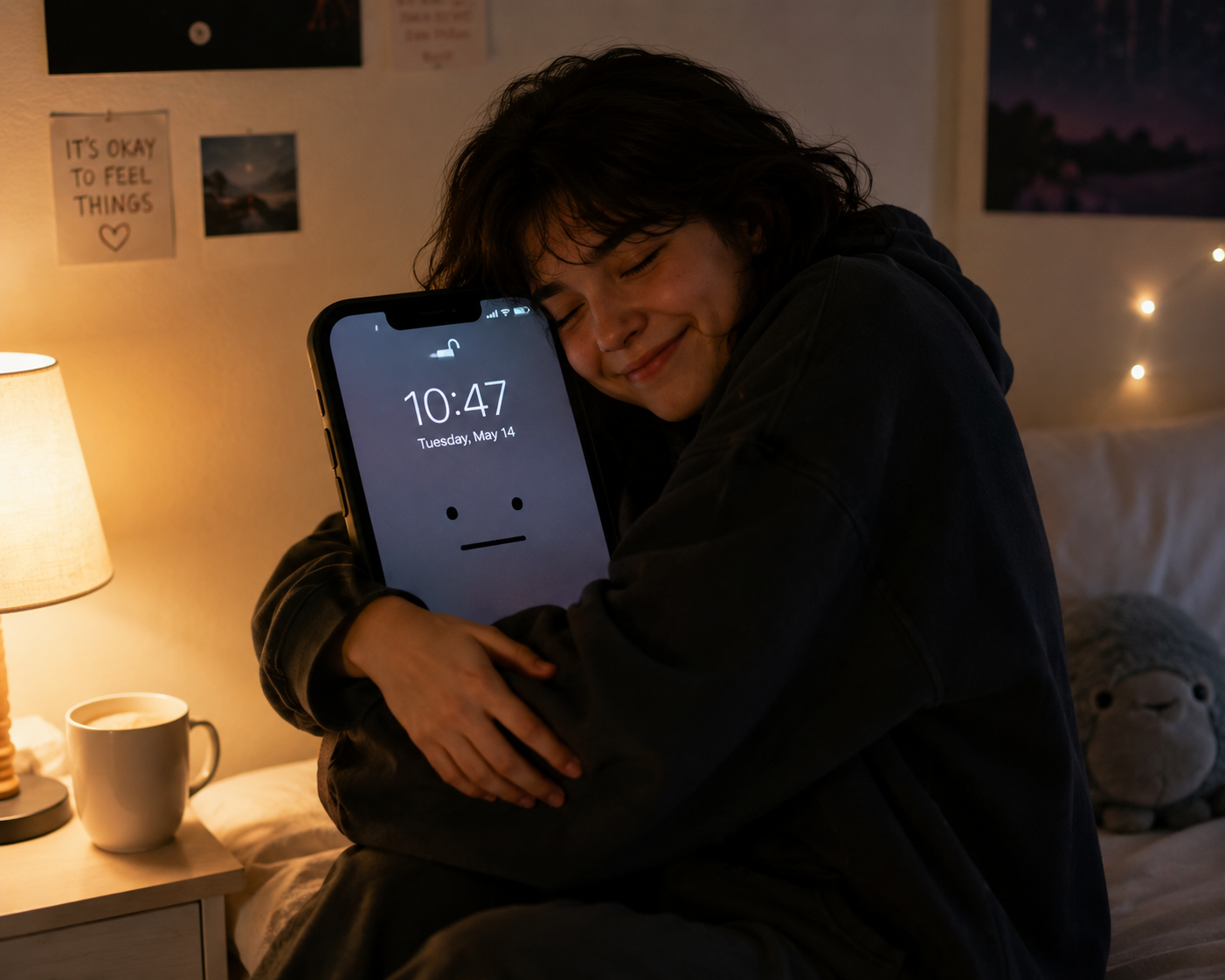
Your Phone Knows You're Sad.
But It Cannot Hug You Back.
A pain that does not show up on any scan, and physically no one can see any broken bone or visible wound. Just a heaviness that sits in your chest and follows you from room to room. This blog is for that kind of pain and for the question of whether technology can reach emotional healing.
Meet Zara, who has every app and still feels empty
Zara is thirty-two. She lives in Karachi. She has a smartphone that tracks her steps, a smartwatch that monitors her sleep, and a laptop that seems to understand her search history better than her closest friend does.
Last month, something in Zara broke and she started feeling heavy. She was lost. Like she was going through the motions of her life while something essential was missing from it.
So she did what most of us do, she opened her AI wellness app.
What the AI Said and What It Missed
The app was fast. Within seconds, it had processed weeks of her data and returned this:
"We notice your typing speed has slowed by 18% this week. Your average resting heart rate is elevated. You have used the words 'tired,' 'heavy,' and 'sad' a combined fourteen times in your journal entries. Based on patterns from 2.3 million users, you may be experiencing early symptoms of anxiety and emotional fatigue. Would you like a guided breathing exercise?"
Zara did the breathing exercise. Then another one which was then followed by a journaling prompt. Then a sleep recommendation. Then a "mood optimization plan" that the app generated based on her usage patterns.
At the end of the session, the app gave her a mood score of 4.2 out of 10 and showed her a neat little chart; red bars for her difficult days, green bars for her better ones. She stared at the chart and even after going through the entire process she still felt completely empty.
Why?
Because the AI could analyze her tears. But it could not feel them.
The AI knew what she was feeling. It could not care that "she was feeling". And that single distinction is the most important thing to understand about technology and emotional healing in 2026 and beyond. We live in a time where the technology built into our apps knows us in ways that can feel almost crazy. You think about something once; a holiday, a product, a feeling you cannot name and by the next morning it is appearing in your ads, your recommendations, your suggested content across every platform you open. The algorithm noticed, it connected dots across your behaviour, your searches, pauses, your scroll patterns, and it drew a conclusion about you before you had fully drawn one yourself.Wellness apps do the same thing at an even more intimate level. They are not just watching what you buy or where you click. They are inside your sleep data, your heart rate, your journal entries, your mood logs, your daily rhythms. They are building a picture of your inner world that is in purely data terms extraordinarily detailed.And still, with every data point and pattern and prediction. The app could not sit with Zara in the car park. It could not stay on the line without saying anything because sometimes saying nothing is exactly what someone needs. It could not feel the weight of what she was carrying and decide, without any algorithm telling it to, that this moment mattered.The data is not the person and the pattern is not the pain. Knowing what someone is feeling is not the same thing, has never been the same thing, as caring that they feel it.That is not a limitation technology will eventually solve. Or perhaps it will? But as of now, that is the difference between intelligence and presence. And presence is what heals.
The Data Is Not the Person
We live in a time of extraordinary self-tracking. We measure our sleep quality, our heart rate variability, our daily steps, our screen time, our stress levels, our cycle, our calories, our mood and we receive this information back as charts, scores, percentages, and predictions.
This is genuinely useful for some things. If you are managing a physical health condition, tracking data matters. If you are optimizing your athletic performance, the numbers help. If you want to notice a pattern you keep missing, a data point can be the thing that finally makes it visible.
But you know what data cannot do..it cannot sit with you.
Data cannot look at you across a table and say, without needing to fix anything, I see you. I am here. Data cannot transmit the felt sense of another human being who has been in the dark themselves and found their way through. Data cannot carry the particular kind of safety that arrives when someone who loves you simply stays in the hard moment, in the silence, in the mess. And that is what healing actually requires.
The Night Zara Stopped Opening Apps
One Tuesday evening, Zara sat in her car in the car park outside her apartment building. She did not open an app. She did not start a breathing exercise. She did not log her mood.
She just cried. A real, messy cry without any app giving a score for the quality of her tears or providing insights. Just tears on her face and her hands gripping the steering wheel.
Then she called her mother. Her mother did not say, "let me analyze your pattern" or "have you tried the 4-7-8 breathing technique?" Her mother said:
"I hear you. I've been there and I know it hurts. I'm sitting with you right now."
And something in Zara, something that the app had not been able to reach in three weeks of daily use, began to change slowly.
What Artificial Intelligence Cannot Replace in Human Healing
This is not an anti-technology argument. Technology has a place in wellness. But the place is narrower than we have been led to believe.
Here is what AI genuinely cannot provide, at least not at the time I am writing this blog:
What Actually Helps: Three Things No Algorithm Can Give You
Zara did not delete her wellness app. She did not throw away her phone or started living in a cave. But she added three things to her life that the app had been quietly replacing.
One: A Real Human Witness
She joined a small online women's circle that meets once a week. They do not give each other advice. They do not analyze each other's patterns. They take turns speaking about what is actually happening, what they are actually carrying while everyone else simply listens. That presence is irreplaceable.
If you do not have access to a circle, a therapist, a ThetaHealing practitioner, or a trusted friend who can truly listen, start with one. One human being who will hear you without immediately trying to fix you.
Two: The Practice of Feeling in the Body
Zara learned to stop thinking about her feelings and to start feeling them in her chest, in her stomach, in her throat. When something surfaced, she would stop. Put her hand on her heart. Breathe into that area of her body. And say, quietly: This hurts. I am here with it.
That one gesture, hand on heart, present and witnessing herself, spoke to her nervous system more directly than a hundred app notifications. This is the practice at the core of somatic and subconscious work. The body holds what the mind tries to manage. And what is held in the body heals not through analysis, but through felt acknowledgment.
Three: Messy, Unmeasured Expression
Zara started writing her real thoughts on paper. It was not structured, just whatever came to her mind without any judgements. Angry, sad, confused, even ugly. She wrote without correcting herself. She drew formless shapes when words ran out,ripped pages, folded things up and never read them again. And she felt freedom in doing that.
There is enormous healing in expression that has no audience, no score, and no expectation of being legible to anyone — including yourself.
A Pattern Is Not a Person. A Prediction Is Not a Presence.
This is the sentence that Zara wrote on a piece of paper and stuck to her bathroom mirror.
Your AI app can identify a pattern in your data. It can predict, with reasonable accuracy, what kind of day you might have tomorrow based on what kind of day you had yesterday. It can suggest interventions that have statistically helped people whose data looks similar to yours.
But you are not the average of 2.3 million users. You are one specific person, with one specific history, one specific nervous system, and one specific set of beliefs about yourself and the world, many of which were formed before you had any language for them.
Healing happens when something stays with you and you finally feel safe enough to release what the nervous system has been protecting. You cannot outsource, optimize or track your way there.
The Role Technology Can Genuinely Play
Let's be honest about what technology can do well in the wellness space:
- It can remind you to breathe.
- It can suggest you go to sleep earlier.
- It can flag a pattern that you have been too close to notice.
- It can give you access to guided meditations and evidence-based techniques that you might not have otherwise found.
- It can connect you to communities of people who understand what you are going through.
These are real, wonderful contributions and I am all for using technology in wellness spaces. The problem is when technology becomes a substitute for human connection, embodied practice, and real therapeutic support rather than a supplement to it.
Use the app, check your sleep score, do the breathing exercise. But do not ask a machine to hold your pain. Your pain deserves more than a chart.
If You Are Feeling This Right Now
If you read this and recognised yourself, if you are the person sitting in the car, staring at a mood score that does not capture what you are actually feeling, here is what I want to say to you directly.
You are not a data point. You are a person with a history, a nervous system, a body that has been doing its best to protect you, and a depth that no algorithm has yet been designed to reach.
The work of healing is not the work of optimization. It is the work of relationship with other people, with your own body, with the parts of yourself that have been waiting for someone to finally be still enough to hear them. That work is not convenient, but it is the only work that actually reaches the places that hurt.
Where to Begin
If you are ready to move from tracking your pain to actually working with it, here are three starting points.
Start with one honest conversation. A real conversation with another human being in which you say, without minimizing: I am not okay. Here is what is actually happening.
Start with your body. Before you open an app today, sit quietly for two minutes. Place your hand on your chest. Ask, without expecting a clean answer: What is here right now? Whatever arises, that is information your app cannot generate.
Start with a practitioner. Whether that is a therapist, a ThetaHealing® session, a somatic bodyworker, or a mindfulness teacher; find someone trained to sit with you in the work.
Let AI track your patterns, let technology do what it does well. But let real love, real tears, and real presence do the true healing. You are not a data point. You are a soul. And souls heal slowly, messily, beautifully, in relationship, in presence, in the particular and irreplaceable company of people who stay.
At Quanta Mind, this is the work we do.
If you are ready to begin or if you are simply curious about what working at this level looks like, send us a message. We are here.
Get in touch